What Is the A2A (Agent2Agent) Protocol? The Standard That Gets AI Agents Talking
MCP solved how an agent uses tools. A2A tackles the next problem: how one agent delegates work to another agent, from another vendor, without custom integrations. What it is, how it works, and why it deserves your attention now.
A year ago the question was which model to use.
Then it became which tools to plug into the model.
Now there’s a new question, and I think it’s the one that will define how we build software with AI over the next few years:
How does an agent work with another agent you didn’t build?
That’s exactly the question A2A (Agent2Agent) answers.
The problem: brilliant agents, but isolated
Almost every company taking AI seriously already runs more than one agent. One handles customers, another reviews invoices, another builds reports, another tests software.
Each can be great at its job. The trouble starts when they need to collaborate:
- The support agent needs the billing agent to review a charge.
- The billing agent was built with a different framework, by a different team, maybe by a different vendor.
- There’s no common language. So someone writes a custom integration. Then another. And another.
It’s the same story we lived through with monoliths before microservices: everything works while it’s small, and it becomes unmanageable the moment it grows.
Without a standard, every pair of agents that needs to talk is a brand-new integration project.
What A2A is, in one sentence
A2A is an open protocol that lets AI agents from different vendors and frameworks discover each other, communicate, and coordinate tasks, without exposing their internal logic and without point-to-point integrations.
A few facts to place it:
- Google introduced it in April 2025, alongside a broad group of technology partners.
- Since June 23, 2025, it has been hosted by the Linux Foundation as an open-source project. This matters more than it seems: it stops being “Google’s protocol” and becomes a standard with neutral governance.
- It’s built on technology we already know: HTTPS, JSON-RPC 2.0, and Server-Sent Events (SSE). No new stack to learn.
A2A vs. MCP: they don’t compete, they complement
This is the most common confusion, so it’s worth clearing up early.
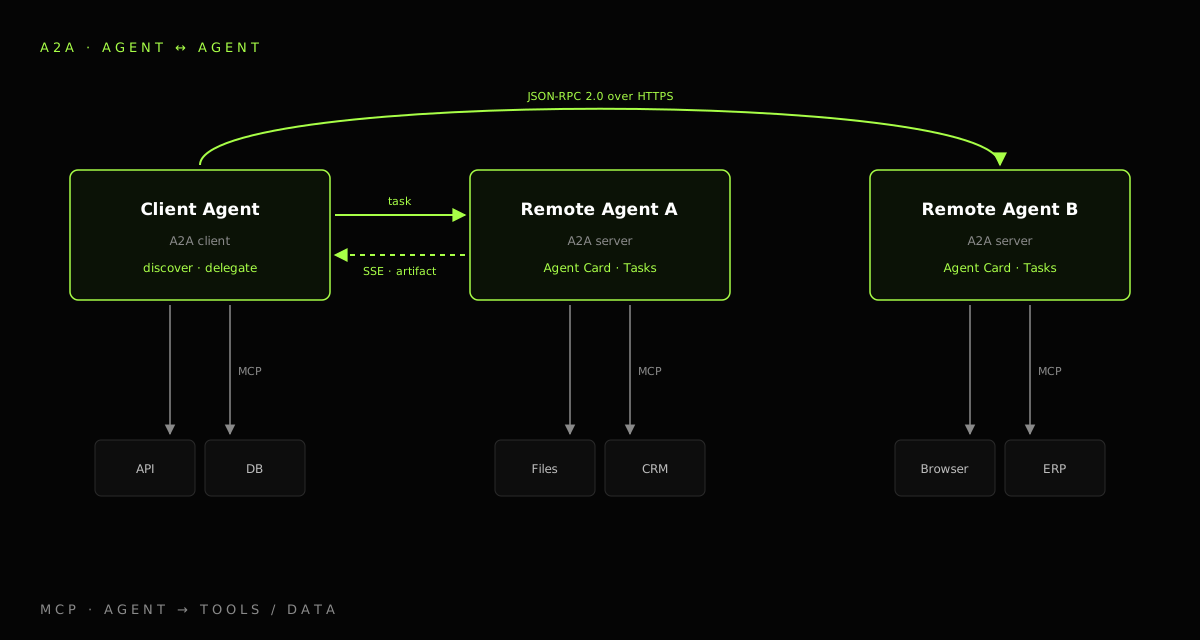
MCP (Model Context Protocol), published by Anthropic in 2024, standardizes how an agent connects to tools and data: APIs, databases, file systems, a browser.
A2A standardizes how an agent connects to another agent.
The clearest way to see it is with two axes:
| MCP | A2A | |
|---|---|---|
| Connects | An agent to tools and data | An agent to other agents |
| Direction | Vertical | Horizontal |
| The counterpart is | A tool that runs what it’s told | An autonomous agent that reasons and decides how to solve it |
| Question it answers | ”What can I use?" | "Who do I delegate this to?” |
| Origin | Anthropic, 2024 | Google, 2025 → Linux Foundation |
In practice, a serious system uses both: MCP gives each agent its capabilities; A2A orchestrates the collaboration between them.
How it works under the hood
A2A follows a client-server model that’s easy to reason about. There are seven pieces:
- A2A Client: the agent (or application) that needs something done.
- A2A Server: the remote agent that receives and processes the task.
- Agent Card: a JSON file where the agent introduces itself — what it can do, how to authenticate, which formats it accepts. It’s its business card.
- Task: the unit of work. It has a unique ID and a lifecycle with defined states.
- Message: each turn of the conversation between client and server.
- Part: the content inside a message or artifact — text (
TextPart), files (FilePart), or structured data (DataPart). - Artifact: the concrete deliverable the task produces — a document, an image, a spreadsheet.
Here’s a simplified Agent Card:
{
  "name": "invoice-review-agent",
  "description": "Reviews invoices and flags duplicate or out-of-policy charges.",
  "url": "https://agents.example.com/invoices",
  "version": "1.2.0",
  "capabilities": { "streaming": true, "pushNotifications": true },
  "securitySchemes": { "oauth2": { "type": "oauth2" } },
  "defaultInputModes": ["text", "application/pdf"],
  "defaultOutputModes": ["application/json"],
  "skills": [
    {
      "id": "detect-duplicates",
      "name": "Detect duplicate charges",
      "description": "Compares an invoice against the customer's history."
    }
  ]
}
And the full flow happens in three phases:
- Discovery. The client agent finds and reads the available Agent Cards to pick the right collaborator.
- Authentication. It authenticates with the schemes the Agent Card declares — the same ones as OpenAPI: API keys, OAuth 2.0, OpenID Connect.
- Communication. It sends the task over HTTPS with JSON-RPC 2.0. If the task is long-running, it gets streaming updates over SSE or push notifications via webhook.
The task lifecycle makes it clear A2A is designed for real work, not instant answers:
submitted → working → input-required → working → completed
                                    ↘ failed
That input-required state is key: the remote agent can stop halfway and ask for more information, like a colleague would. It’s not an endpoint that answers and forgets.
The design principles that make it interesting
What I like most about A2A isn’t any single feature. It’s a set of design decisions:
- Agents are opaque. An agent collaborates without revealing its prompt, internal memory, or tools. It only exposes what it declares in its Agent Card. For a company, that’s what makes collaborating with third-party agents possible without handing over its competitive edge.
- Existing standards, not inventions. HTTP, JSON-RPC, and SSE are already in every stack, every gateway, every observability tool.
- Enterprise-grade security by design. Authentication and authorization aren’t bolted on later: the Agent Card declares how to authenticate before any conversation starts.
- Built for long-running tasks. Streaming, push notifications, and intermediate states. An agent may take minutes or hours, and the protocol assumes it.
- Modality-agnostic. Text, files, structured data — and the roadmap includes negotiating audio and video inside the conversation.
Where it makes sense
A2A shines when a problem needs several coordinated specialists, not one generalist doing everything:
- Insurance claims. One agent analyzes documents, another detects fraud, another keeps the customer updated.
- Supply chain. Inventory, logistics, and pricing agents react in real time to shifts in demand.
- Customer service. Marketing, sales, and support collaborate on the same case without the customer repeating their story.
- Assisted medical diagnosis. Radiology, pathology, and symptom specialists combine their judgment on a single case.
It’s the same pattern that made microservices the standard: instead of a monolith that knows everything, an ecosystem of specialized pieces working toward a shared goal.
I held it up against my own pipeline
I work on a pipeline of QA automation agents: one plans the test cases, another explores the application, another generates the scripts, and another runs them and repairs them when they fail.
Today those agents talk over REST endpoints we designed ourselves. It works, but every contract is homegrown: anyone who wants to integrate has to read our docs, understand our schemas, and adapt to our way of reporting progress.
Reading the A2A spec, the parallel is direct:
- Each agent would publish its Agent Card instead of a Swagger you read by hand.
- Progress on a long run would be standard SSE streaming, not a format we invented.
- The moment an agent needs a human decision already has a name in the protocol:
input-required. - And the most interesting part: an agent from another team, or another vendor, could delegate a task to the executor without anyone writing an integration.
It’s not that what we have is wrong. It’s that A2A turns into a standard exactly the decisions every team is making on its own today.
The challenges you shouldn’t ignore
It would be dishonest to sell it as a free lunch:
- Standards uncertainty. There are competing specifications, and the protocol version keeps evolving. Betting on it today carries some risk.
- More operational complexity. Several agents collaborating are harder to debug, monitor, and cost out than a single one.
- Security and governance. Agent-to-agent communication means new attack surfaces: agents impersonating others, malicious Agent Cards, injected instructions traveling from one agent to the next.
- Higher upfront effort. For a simple case, a single agent with good tools is still cheaper.
That’s why integration and orchestration platforms are still needed: A2A and MCP are the backbone, but someone has to enable, monitor, audit, and govern those interactions.
Why pay attention now
Protocols are decided early.
HTTP didn’t win by being perfect: it won because it arrived at the right moment and everyone adopted it. We’re seeing the same thing with MCP at the tools layer — in a short time it went from a proposal to what everyone expects an agent to support.
A2A is at that same point for the agent collaboration layer. With Linux Foundation governance, built on standards that already exist, and a roadmap that includes formal authorization in Agent Cards and dynamic capability verification, it has everything it needs to become the de facto standard.
And when that happens, the question won’t be “is my agent good?” but “can my agent work with the others?”
My take
In earlier posts I wrote that AI is shifting from a chat in a browser tab to infrastructure that runs in the background. A2A is the missing piece of that story: if agents are going to be processes we manage, they need a common language to coordinate, just like services needed HTTP and APIs needed contracts.
My practical advice: if you’re designing a multi-agent system today, even if you don’t adopt A2A yet, design as if you will. Declare what each agent can do, model tasks with explicit states, and clearly separate “tools” (MCP) from “colleagues” (A2A). Migrating later will be far cheaper.
What do you think?
Do you think A2A will become the “HTTP of agents,” or will we end up with several protocols competing for years before one wins?
I’d love to hear your take.
Sources
- What is the Agent2Agent (A2A) protocol? — IBM Think (Spanish). Definition, history (Google, April 2025; Linux Foundation, June 23, 2025), the seven components, the discovery → authentication → communication flow, the MCP comparison, and the roadmap.
- What is A2A? The Agent2Agent protocol — Alumio (Spanish). The vertical (MCP) vs. horizontal (A2A) integration distinction, benefits, adoption challenges, use cases, and the role of the orchestration layer.
- Official A2A project documentation. Spec, SDKs, and implementation samples.